Log the set you did.
I explored how a previous set can help with today’s entry without silently becoming today’s result. The central artifact is the input itself: draft, units, confirmation and correction.
Independent design study. Not commissioned by Ladder. Proposed work, revised October 2026.
The journal is part of the workout, not a separate destination.
The journal flow I reviewed sits in an active workout. A sheet contains exercises, effort, time, reps, weight and access to history. Numeric entry exposes a keyboard and units. That context matters more than how tidy the journal looks on a presentation board.
An empty weight field is not automatically a UX failure. It may simply mean today’s set has not been entered. My narrower hypothesis is that a returning member sometimes needs a previous record while deciding what to enter. I would first compare an inline reference with the existing View History route.
In this revision I made the input interaction the central artifact. I also expanded the illustrated scope explicitly: the proposal includes a focused set editor, not only a new history card above an unchanged table. That is a larger change and must earn its cost.
Copying a number is convenient. Confirming a result means something else.
I considered an automatic suggestion, a copied editable value and a reference kept outside the input. I chose the reference. A record from September 24 describes that day; it does not establish what happened in the current set.
The cost is screen space and another piece of information to interpret. If it distracts experienced members or reads as coaching advice, an on-demand reference may be better. I have not validated that choice in a workout setting.
The proposal labels the previous date, reps and effort, then gives today’s input its own heading. A different weight is ordinary data. Nothing congratulates someone for matching the past or implies that a higher number is required.
Make the moment of confirmation visible.
I first separate the last set from today’s empty fields. Only a deliberate entry turns those fields into a draft. In the next screen, today’s 22 kg and 10 reps remain unconfirmed while the keyboard is open; the historical 24 kg stays outside the input.
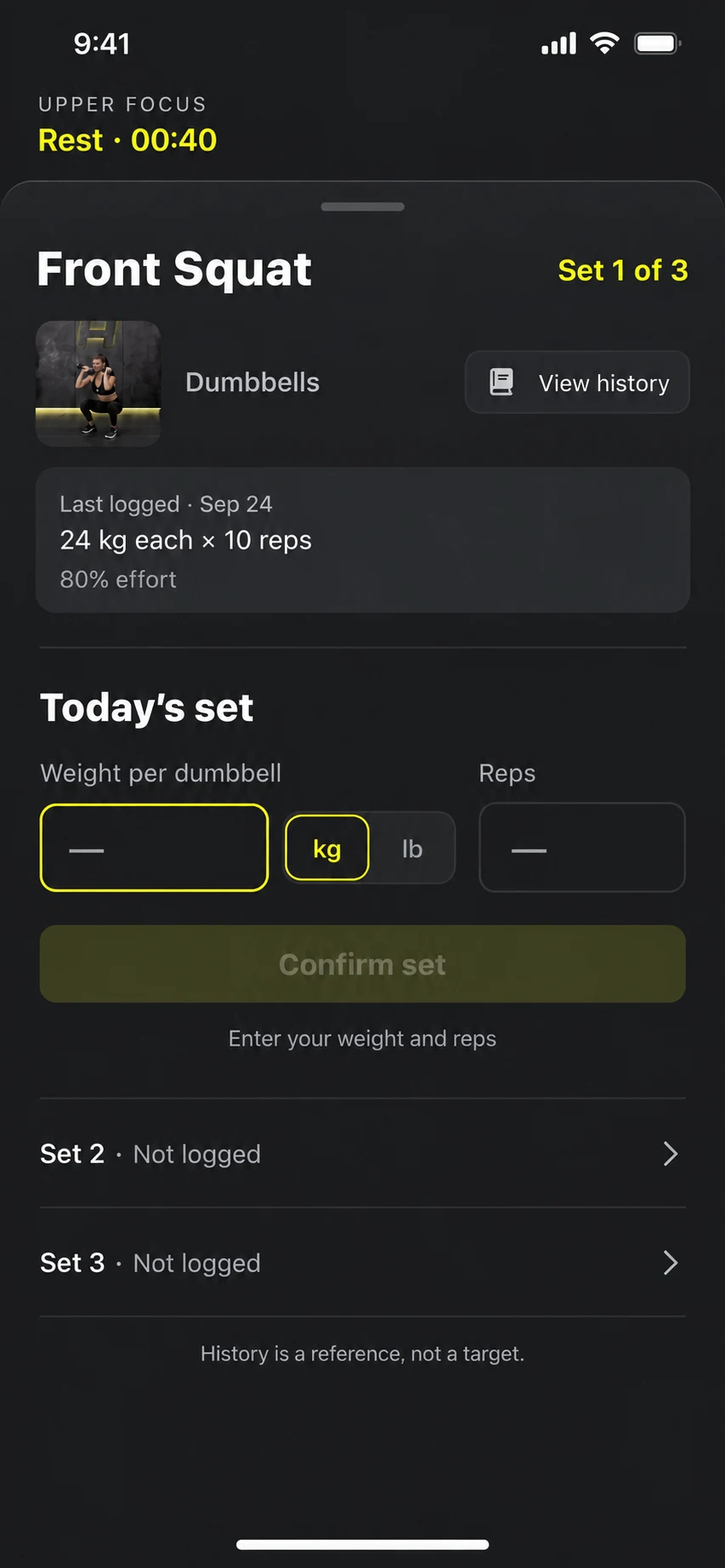
I show the last set as reference while leaving today’s weight and reps blank. Automatic copying would save entry work but could turn an unperformed set into apparent data. Confirmation waits for an entry.
Authored starting state · Sample per-dumbbell convention; no training recommendation.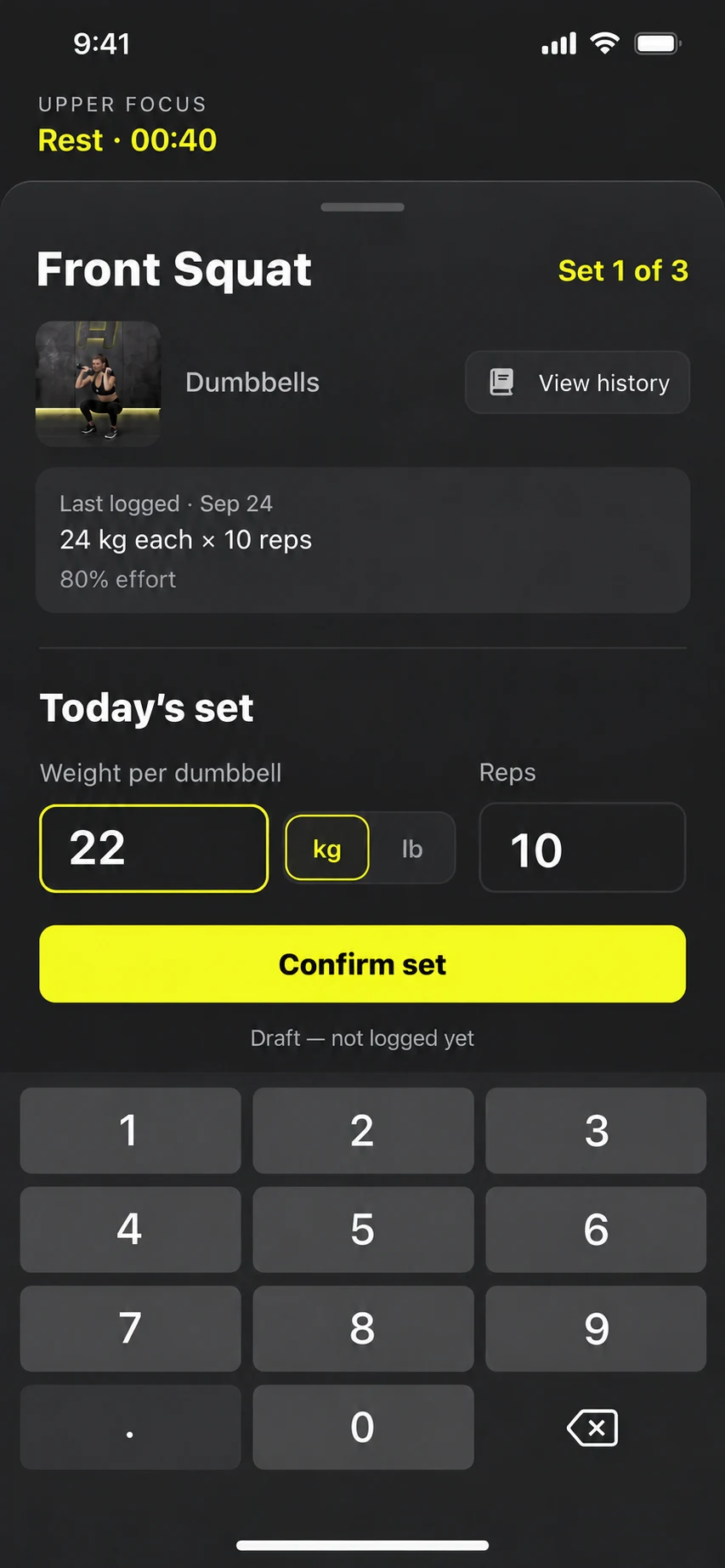
I kept the previous 24 kg outside the editable field. Today’s 22 kg is a deliberate draft; comparing the two must not turn yesterday’s load into a recommendation.
Authored draft · Sample per-dumbbell convention. The focused editor expands the original inline-history scope.This is a proposed focused editor over the workout context, not simply a history card inserted above an unchanged table. I chose that larger surface to keep the reference, current field and confirmation visible with the keyboard. It must earn that space in a real workout. “Per dumbbell” is an explicit convention for this authored example; Ladder’s actual convention must be confirmed before implementation.
A unit switch must not change the workout record.
I rejected changing only the unit label. The same draft appears as 22 kg or 48.5 lb at the chosen display precision; the previous 24 kg becomes 52.9 lb. The underlying quantity must survive repeated switches without accumulating rounding error.
The keyboard stays open after the unit switch because editing is still in progress. Only Confirm set closes it and changes the record’s state. I keep Edit this set on the outcome screen rather than forcing someone to rediscover correction through history.
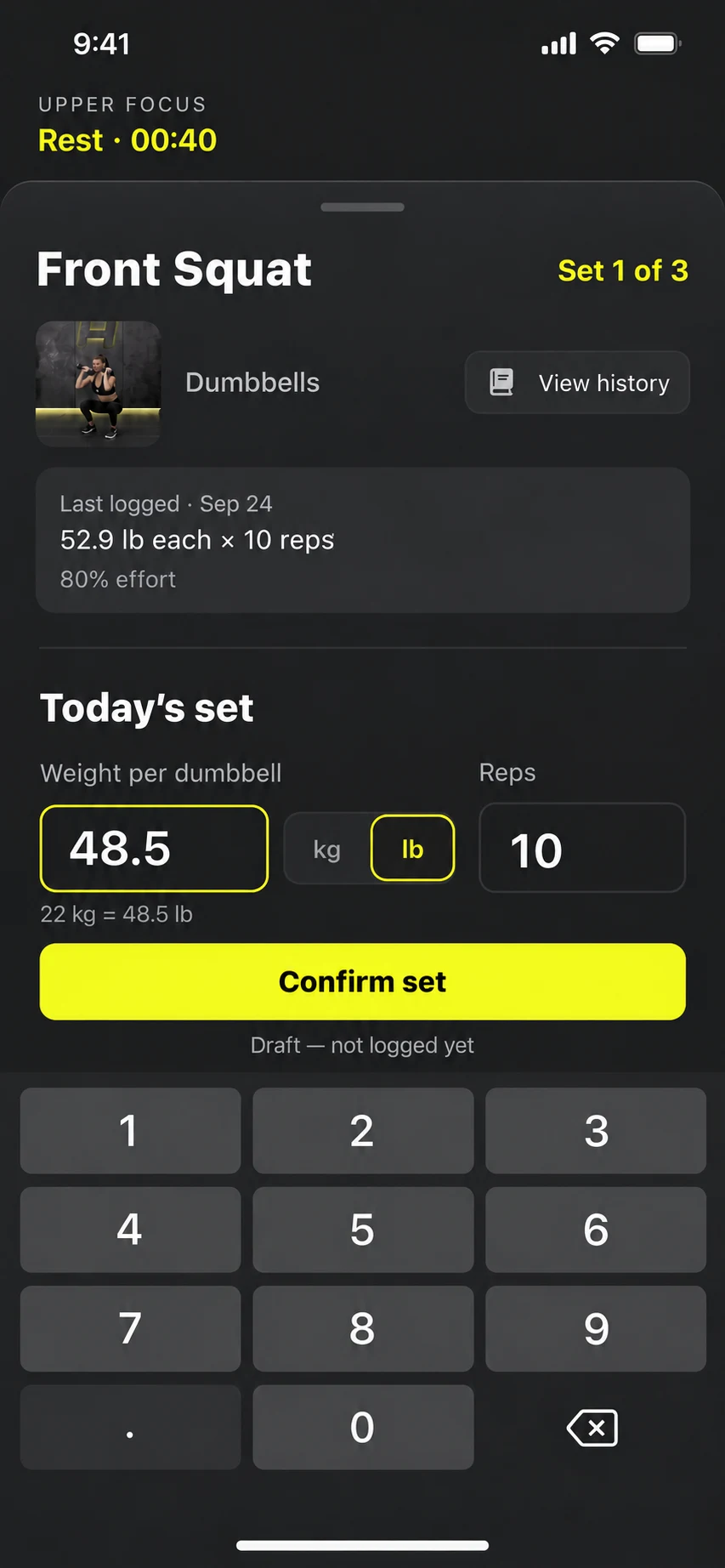
I convert both today’s draft and the historical reference so they remain comparable: 22 kg becomes 48.5 lb, and 24 kg becomes 52.9 lb at display precision. Switching units does not confirm the set.
Authored draft · Rounded display values. Production conversion must preserve the underlying quantity across repeated switches.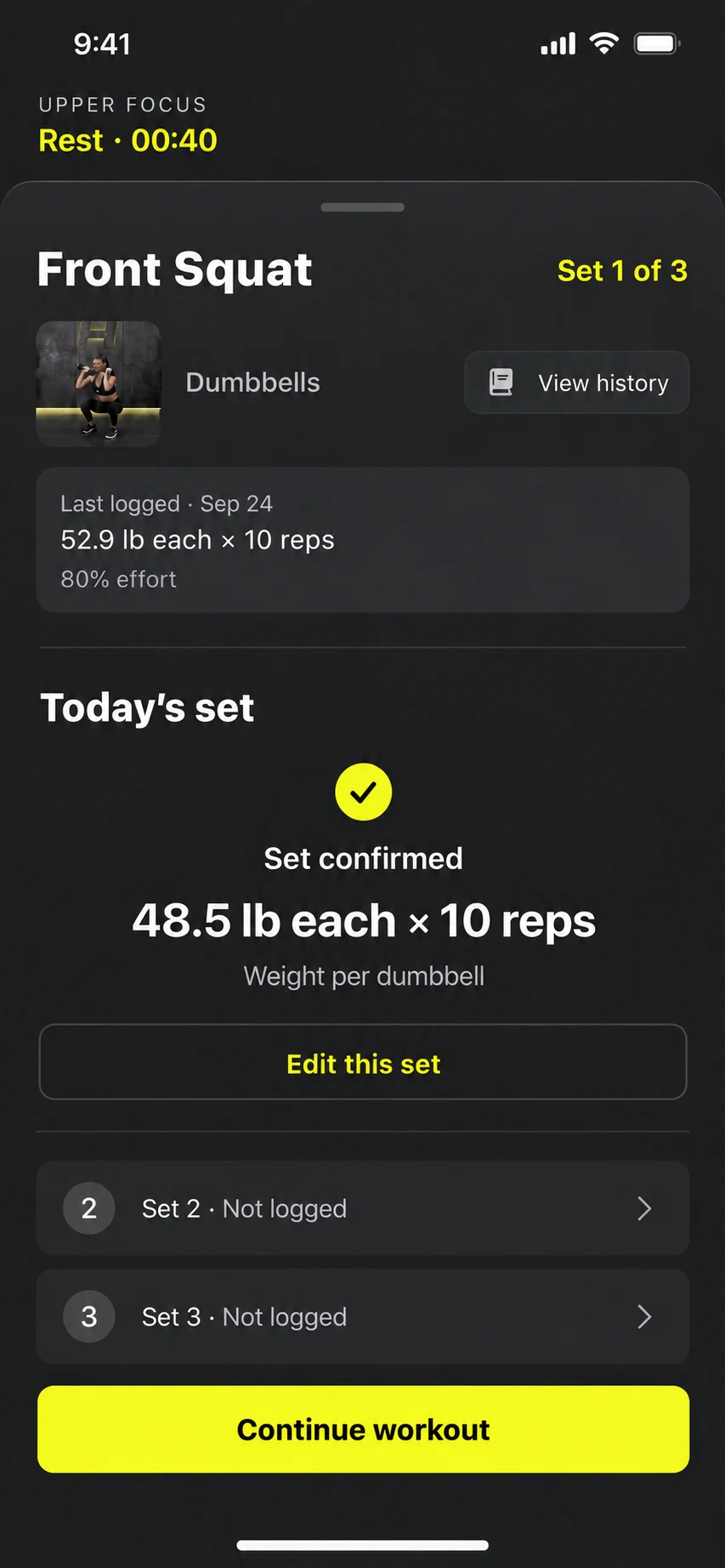
I dismiss the keyboard and label only this set Confirmed. The remaining sets stay unlogged, and Edit this set keeps a correction within reach. Confirmation must not fill the rest of the workout.
Authored outcome · Follows the converted draft. This image does not demonstrate server synchronization.The four images make empty, draft, converted draft and confirmed states inspectable together. They specify behavior; they do not prove native keyboard handling, saved account data or synchronization. No other set is marked complete by this action.
Similar names do not make two loads comparable.
My matching rule starts with movement identity, equipment, side and recording convention. Effort can differ if the difference is visible. An ambiguous convention is a reason to withhold comparison.
| Historical context | Show beside this set? | Reason |
|---|---|---|
| Same movement, dumbbells, known per-dumbbell convention | Yes, with date and effort | The quantity has a defined meaning |
| Same display name, different equipment | No equivalent-load reference | The conditions changed |
| Same movement, convention unknown | No numeric comparison | I cannot explain the number safely |
| History request fails | Offer retry; allow entry | Missing data is not evidence of no history |
Changing equipment should clear an incompatible reference immediately. It should not silently reinterpret a draft. A late history response must not overwrite the member’s input. These are proposed interaction contracts to verify with engineering and coaching owners, not an assertion about Ladder’s architecture.
Keep the draft and explain what is known.
The production design would distinguish an unsaved draft, a record stored on the device and a server-confirmed record. A failed history lookup should not block any of them. Retry must reconcile one operation rather than manufacture another set.
The screen sequence defines the distinction between a draft and a confirmed entry. Offline persistence, restart recovery and cross-device conflict handling still need implementation and separate tests. A confirmation image is not evidence that those reliability requirements have been solved.
Useful context must beat extra density.
I would run situated prototype sessions with people who already track strength workouts. In a pause between sets, they would inspect history, enter a different load, change units and correct a record. I would observe wrong-unit entries, lost drafts, confusion between past and present, and the need to reopen history. Time is secondary to correctness.
The feature should be reduced or removed if it is interpreted as a recommendation, obstructs the keyboard, or adds work without helping the target scenario. Increased set logging would not compensate for those failures. These sessions are planned. The authored screens make the decisions reviewable, but are not usability evidence.
Returning members are the reachable audience.
The reference only helps when compatible history exists. Applying a potential benefit to every subscriber would overstate reach. The recurring cost also includes movement metadata, unit conventions and regression maintenance, not just a few interface components.
I would first validate the need and the input interaction. Only then would I consider a larger behavioral test of useful journal use while protecting workout completion. Retention remains a downstream hypothesis, not a result of this proposal.
My main decision is now visible in the work itself: keep the previous record as evidence, make today’s entry editable, and require an intentional confirmation. The next question is whether that clarity survives the pace and constraints of a real workout.